

When Healthcare Crosses the Line Into Exploitation#
Hospitals are institutions built on trust. Patients and families approach them at moments of extreme vulnerability, believing that care - not profit - will guide every decision. When that trust is misused, the law must step in.
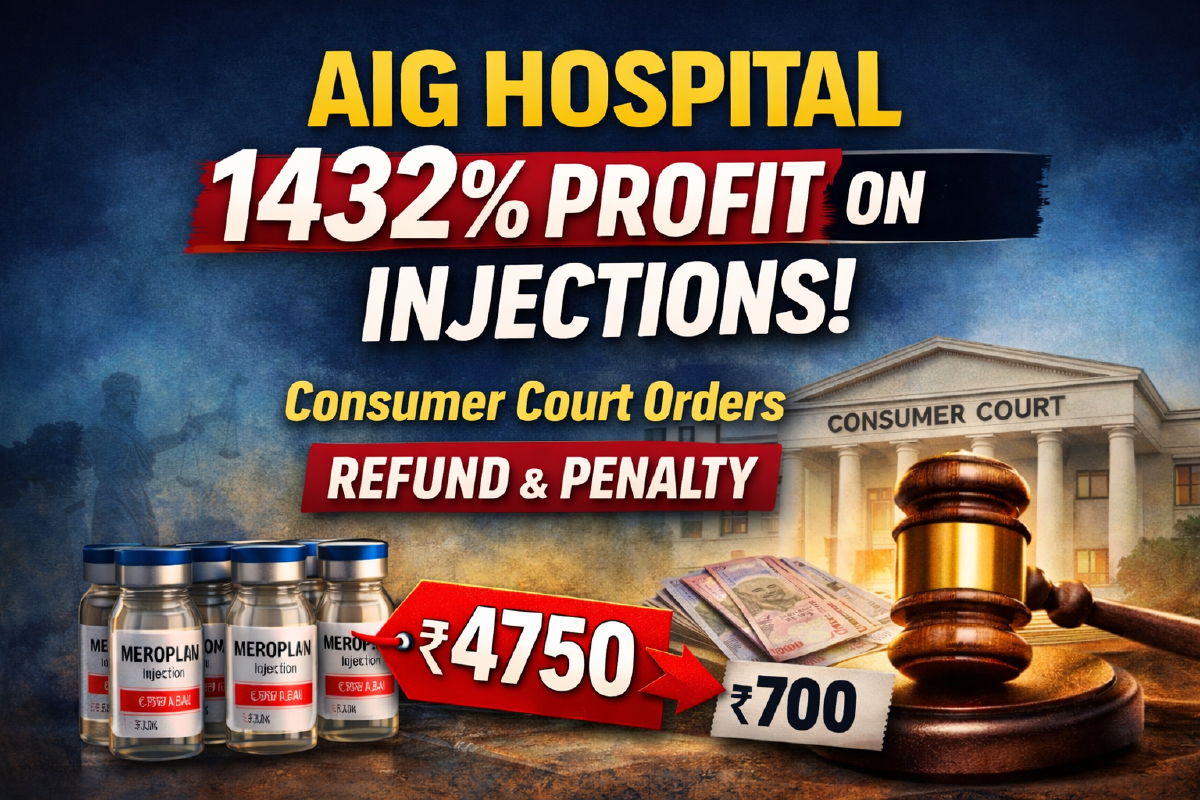
In a strong and principled judgment, the District Consumer Disputes Redressal Commission, Ranga Reddy exposed how a private hospital charged exorbitant prices for a life-saving injection, earning an unconscionable 1432% profit at the cost of a grieving family.
This case is not about medical negligence.
It is about ethical failure and unfair trade practice.
Background of the Case#
The complainant, a 72-year-old senior citizen, approached the Consumer Commission after discovering shocking discrepancies in hospital billing during his wife’s prolonged treatment between May and July 2022.
Throughout her hospitalisation, she was administered Meroplan 1 GM (Meropenem) injections multiple times as part of her treatment protocol.
The complainant never disputed the quality of medical care. His grievance arose only after learning that the same injection was available outside the hospital at a fraction of the price.
The Price Shock That Triggered the Case#
During treatment:
- The hospital charged ₹4,750.19 per injection
- The same injection was available at a retail pharmacy for ₹700
- Hospital procurement records revealed a bulk purchase price of ₹310 per injection
In total, 79 injections were administered.
This translated into a profit of approximately ₹4,440 per injection, leading to a total excess amount running into several lakhs.
The Commission later calculated the profit margin at an astounding 1432.26%.
Hospital’s Defence and the Commission’s Response#
The hospital attempted to justify its pricing by citing:
- Internal pharmacy policies
- Reliance on MRP printed on invoices
- Claims that patients were free to purchase medicines elsewhere
However, the Commission found these arguments contradictory and misleading.
It noted that:
- The hospital itself purchased injections at ₹310 in bulk
- No fair or reasonable pricing policy existed
- Blind reliance on MRP cannot legitimise exploitative pricing
- Patients in hospitals are captive consumers, not free-market negotiators
The Commission firmly rejected the argument that internal policies could override consumer rights.
Findings of Unfair Trade Practice#
After examining bills, invoices, prescriptions and evidence, the Commission held that:
- Charging ₹4,750 for an injection procured at ₹310 is unethical
- The hospital deliberately exploited patient vulnerability
- Failure to respond to the complainant’s legal notice amounted to deficiency in service
- Such conduct squarely falls under Unfair Trade Practice under consumer law
The Commission made it clear that healthcare cannot be converted into a profit-maximising enterprise.
Relief Granted by the Consumer Court#
The complaint was allowed in part, and the hospital was directed to:
Refund#
- ₹3,50,775/- towards excess amount charged
- Interest @ 9% per annum from 24.07.2022 till realisation
- 12% interest in case of default
Compensation and Costs#
- ₹30,000/- for mental agony and financial loss
- ₹10,000/- towards litigation costs
Punitive Damages#
- ₹1,00,000/- to be deposited into the Consumer Welfare Fund
- Imposed under Section 39(1)(d) of the Consumer Protection Act, 2019
The hospital was granted 45 days to comply with the order.
Why This Judgment Is Important#
This decision is a wake-up call for private healthcare providers across India.
It establishes that:
- Hospitals cannot hide behind MRPs to justify profiteering
- Ethical pricing is part of healthcare responsibility
- Consumer courts will intervene where exploitation is evident
For patients and families, this judgment reaffirms that consumer law applies even inside hospital walls.