
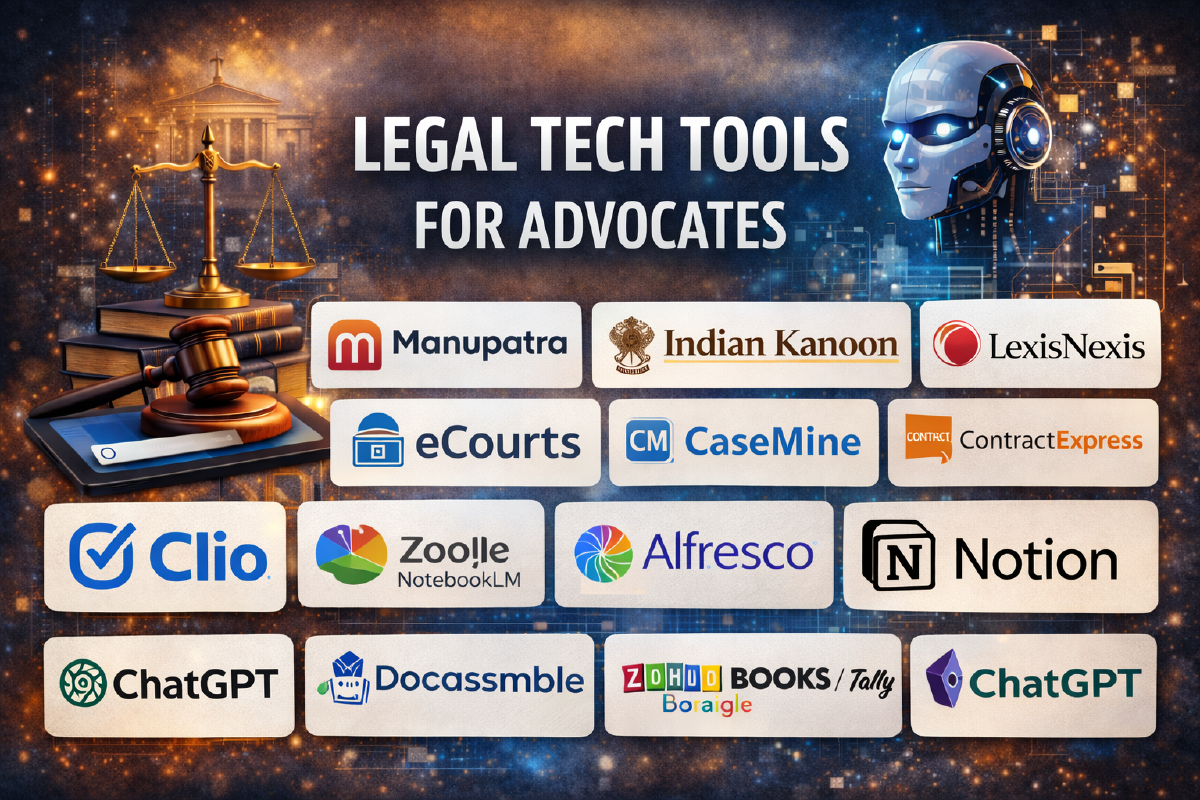

The modern legal profession is no longer limited to law books and courtrooms. Today, effective advocacy requires efficient legal research, intelligent case analysis, document automation, and disciplined knowledge management.
This post curates practical, advocate-tested legal technology tools, organised by purpose, with quick descriptions and official links.
🔍 Legal Research Platforms#
Manupatra#
🔗 https://www.manupatrafast.com
One of India’s most comprehensive legal research databases, providing access to Supreme Court and High Court judgments, statutes, rules, notifications, circulars, and expert commentary. Extensively used by courts and senior advocates.
Best for: Authoritative Indian legal research and citation-based arguments.
Indian Kanoon#
A free legal research platform offering judgments from Supreme Court, High Courts, and tribunals. Ideal for quick look-ups and preliminary research.
Best for: Law students, junior advocates, and fast keyword searches.
⚖️ Judgments & Orders Portals#
LexisNexis India#
A premium legal research platform with Indian and international case law, statutes, journals, and analytical tools. Particularly useful for commercial and comparative law.
Best for: Advanced research and corporate litigation.
Judgment & Order Search Portal (eCourts)#
🔗 https://services.ecourts.gov.in/ecourtindia_v6/
Official Government of India portal to search district court judgments, orders, cause lists, and case status across India.
Best for: Trial court practice and case tracking.
🤖 AI-Powered Legal Research#
CaseMine#
An AI-driven legal research platform offering contextual search, citation analysis, and judge analytics, enabling discovery of relevant precedents beyond simple keyword searches.
Best for: Strategic litigation research and precedent discovery.
CaseText#
An AI-assisted legal research platform popular in international jurisdictions, known for case analysis and contextual summaries.
Best for: Conceptual clarity and foreign case law research.
📄 Document Drafting & Automation#
ContractExpress#
🔗 https://www.contractexpress.com
A document automation tool for creating rule-based, standardized legal documents efficiently.
Best for: Law firms handling repetitive contracts and agreements.
Docassemble#
An open-source platform for automated legal document generation using guided interviews. Widely used in legal aid and access-to-justice initiatives.
Best for: Legal automation projects and tech-enabled practices.
📁 Case & Practice Management#
Clio#
A cloud-based practice management software covering case management, billing, calendaring, and client communication.
Best for: Solo practitioners and small law firms.
Casebox#
An AI-enabled platform for case analysis, document review, and litigation preparation, particularly useful in commercial disputes.
Best for: Complex litigation teams.
📚 Knowledge Management & Precedent Libraries#
HighQ#
An enterprise-grade collaboration and knowledge management platform designed for large law firms and in-house legal teams.
Best for: Secure document sharing and institutional knowledge management.
Alfresco Community Edition#
🔗 https://www.alfresco.com/products/community
An open-source document and content management system that can be customized to build internal precedent libraries.
Best for: Firms seeking open-source knowledge management solutions.
🧠 AI & Productivity Tools for Advocates#
Google NotebookLM#
An AI research assistant that works only on documents uploaded by the user, reducing hallucination and improving reliability.
Practical Use:
- Upload judgments, pleadings, RTI replies
- Generate issue-wise summaries
- Prepare case briefs and arguments
Best for: Case preparation, PIL research, and exam revision.
ChatGPT#
An AI assistant useful for drafting, restructuring, simplifying legal language, and brainstorming arguments. Should always be used alongside primary legal research.
Best for: Drafting support and conceptual clarity.
📖 Deep Reading & Annotation#
LiquidText#
A powerful tool for deep reading and visual analysis of long documents such as judgments, statutes, and contracts. Allows users to pull excerpts into a single workspace and connect ideas visually.
Practical Use:
- Analyze lengthy SC/HC judgments
- Extract ratios and issue-wise notes
- Prepare argument structures
Best for: Litigators, appellate practice, and PILs.
📝 Notes, Knowledge & Long-Term Learning#
Zotero#
A free reference management tool to collect, organize, annotate, and store judgments and legal articles.
Best for: Research-heavy practice and legal writing.
Obsidian#
A local-first knowledge management tool that allows advocates to interlink cases, sections, arguments, and principles, creating a personal legal knowledge graph.
Best for: Serious litigators and appellate advocates.
Notion#
An all-in-one workspace for case tracking, research notes, hearing logs, and study planning.
Best for: Workflow and personal practice management.
🧾 Accounting & Compliance (Solo Practice)#
Zoho Books / Tally#
Useful for fee receipts and financial records of legal practice.
Final Thoughts#
Legal excellence today is not just about knowing the law—it is about finding it faster, understanding it deeper, and applying it strategically.
Technology will not replace lawyers, but lawyers who use technology will replace those who don’t.
This list is designed to help advocates build a disciplined, ethical, and future-ready legal practice.