
The Right to Information Act of 2005 was intended to be the sunlight that serves as the best disinfectant for corruption. However, in Telangana, the sun is setting on transparency.
The Right to Information Act, 2005 was enacted to dismantle the culture of secrecy that long protected corruption and administrative arbitrariness in India. Transparency was not envisioned as a favour by the State, but as a citizen’s enforceable right, flowing directly from Articles 14, 19(1)(a), and 21 of the Constitution.
Yet in Telangana, the RTI Act has not been repealed, suspended, or amended away.
Instead, it has been quietly neutralised through systemic non-implementation.
This article documents how the RTI framework in Telangana has collapsed - not through overt defiance, but through silence, delay, non-use, and technical obstruction - using official data supplied by the Government itself.
This is not a story of inefficiency.
This is a story of institutional sabotage.
Supreme Court Mandate: Law Without Ambiguity#
In Writ Petition (Civil) No. 1040 of 2019 (Pravasi Legal Cell v. Union of India), read with W.P.(C) No. 1325 of 2020, the Supreme Court of India issued a binding direction:
All States and Union Territories shall set up and operationalize online RTI portals for all public authorities within their jurisdiction within 3 Months.
The intent was unmistakable:
- Universal digital access
- Elimination of bureaucratic gatekeeping
- Standardised accountability
- Real-time monitoring of RTI compliance
This was not a suggestion.
It was a constitutional command.
Telangana’s Formal Compliance, Substantive Defiance#
Telangana launched its RTI portal https://rti.telangana.gov.in/ on 15th December 2022.
On paper, the State complied.
In practice, the portal became a digital mirage - visible, but unusable.
The Statistical Indictment: RTI Reduced to 2% Reality#
As per the official RTI reply issued by the Information Technology, Electronics and Communications (ITE&C) Department:
RTI Applications (Dec 2022 – Dec 2025)#
- Total RTI Applications Filed : 17,865
- Total RTI Applications Disposed: 377
That is a disposal rate of approximately 2%.
The Reality: A staggering 98% of online RTI applications remain effectively unaddressed or lost in the digital void.
This is not administrative backlog.
This is administrative abandonment.
First Appeals: A Statutory Remedy That Does Not Function#
The collapse is even more severe at the appellate stage:
- First Appeals Filed: 2,502
- First Appeals Disposed: NIL
Not one.
Not a single appeal decided.
A statutory remedy reduced to a decorative illusion.
A Portal Without Participants: 99.5% Non-Usage#
Perhaps the most damning disclosure:
- Public Authorities Onboarded on Portal: 3,323
- Public Authorities Actually Using Portal: 17
- Public Authorities Not Using Portal: 3,306
That means 99.5% of Telangana’s public authorities are ignoring the RTI portal.
This includes the ITE&C Department itself - the very authority responsible for developing and maintaining the portal.
When the watchdog refuses to watch, corruption doesn’t need protection - it gets permission.
Real-Time Breakdown: Portal Not Functioning#
As of January 2026:
- 10,823 citizens are registered on the Telangana RTI portal
- For the last two consecutive days, the portal has been non-functional
- OTPs are not being triggered
- RTI applications cannot be submitted
When digital access is mandated and the system fails, the State effectively suspends the RTI Act without authority of law.
A right that exists only when servers cooperate is not a right - it is a controlled privilege.
A 20-Year-Old Law Still Awaiting Implementation#
The RTI Act is now over 20 years old.
If the State has no intention to implement it, the question must be asked openly:
If transparency is inconvenient, why not repeal the RTI Act honestly instead of strangling it quietly?
Symbolic laws with zero enforcement are worse than repealed laws—they deceive citizens into believing rights exist when they do not.
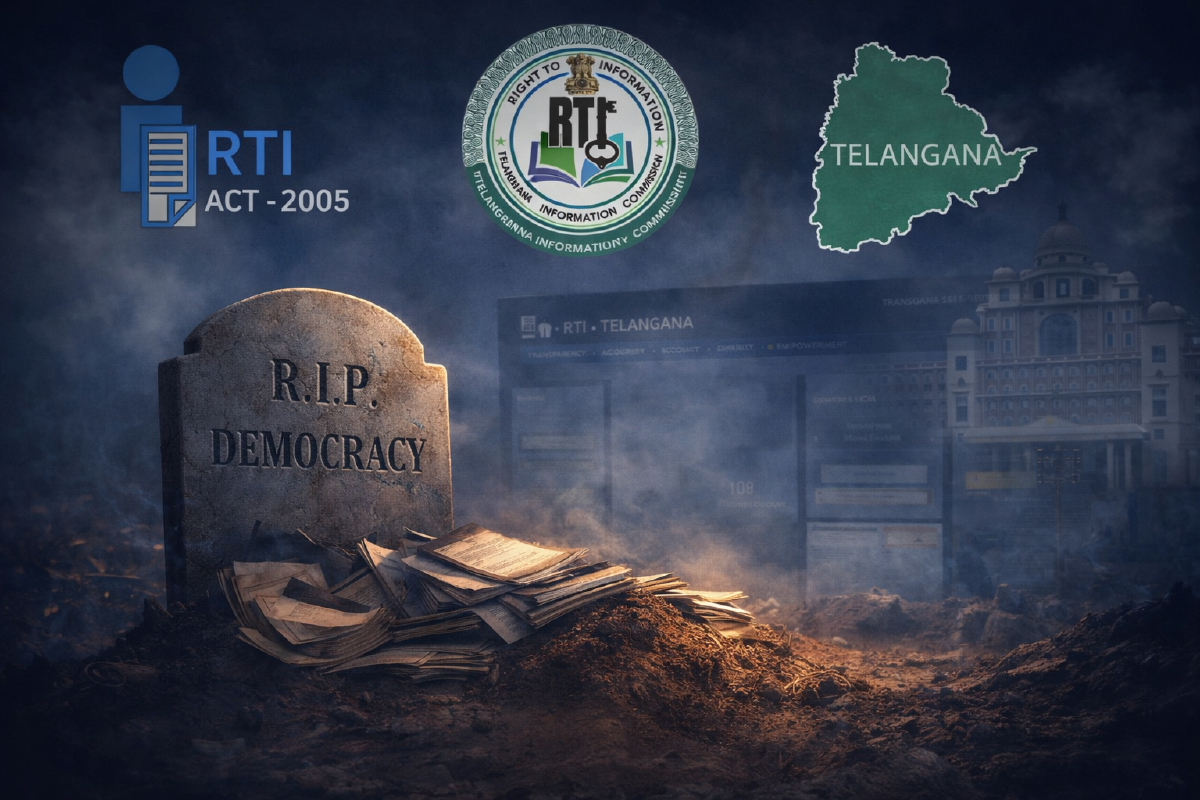
Conclusion: Democracy Buried by Silence#
This Is Not About a Portal. This Is About Democracy.
RTI is not a software feature. RTI is not a department. RTI is the citizen’s right to question power.
When:
Applications are not answered
Appeals are not heard
Authorities are not monitored
What dies is not transparency alone.
What dies is democracy itself.
This is not an administrative lapse.
It is the systematic burial of democratic accountability.
Democracy does not always die loudly.
Sometimes, it dies quietly - behind “Processing” screens, empty dashboards, and unanswered appeals.
In Telangana today, the Right to Information has effectively become the Right to Ignore.